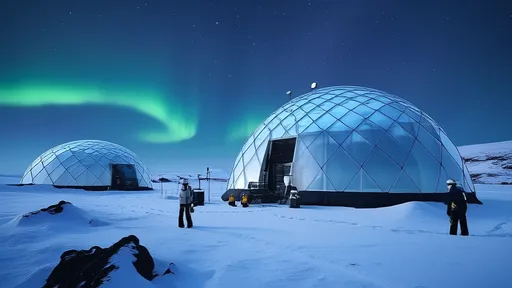
Arctic Research Station Employs Inflatable Smart Materials
Imagine a structure that can inflate itself in hours, withstand Arctic gales, and monitor its own structural health while keeping scientists cozy at -50°C. This isn't science fiction—it's the next generation of polar research stations, now moving from blueprint to reality thanks to smart, air-filled materials. For decades, building in the Arctic meant hauling heavy materials across treacherous ice, a slow, expensive, and environmentally disruptive process. The result was often rigid, permanent bases that couldn't adapt to shifting ice or new research needs. The logistical nightmare of traditional construction is finally meeting its match.
The core innovation lies in composite fabrics integrated with pneumatic systems. These aren't simple inflatable tents; they are multi-layered membranes with a weave of advanced polymers and embedded sensor networks. One outer layer is designed for extreme tear resistance, while an inner thermal layer often contains aerogel or vacuum-insulated panels. When a transport plane delivers a compact package to a site, high-strength fans pump in air, and the structure self-erects, its internal skeleton of air beams locking into a resilient dome or modular corridor system. The entire process can be completed by a small team in less than a day, a stark contrast to the multi-season builds of the past.
What makes these materials "smart" is their embedded technology. The fabric itself is woven with fiber-optic sensors that act as the station's nervous system. They continuously monitor for stress points, strain from snow load, and even the slightest drop in internal pressure. This data is fed to a central system that can alert inhabitants to potential issues long before they become critical. Some prototypes are experimenting with materials that change their insulating properties in response to external temperatures, becoming more reflective in the summer midnight sun and more absorbent during the dark winter, effectively helping to regulate the interior climate passively.
The operational benefits are transformative, particularly for scientific work. A station can be deployed rapidly for short-term, urgent research campaigns, such as tracking an unexpected ice shelf calving event. Its lightweight nature significantly reduces the environmental footprint on pristine polar landscapes. Furthermore, the modularity means that labs, living quarters, and communal spaces can be reconfigured or expanded as research teams and their objectives change. This flexibility is a game-changer for long-term studies that evolve over years, allowing the infrastructure to adapt to the science, not the other way around.
Of course, pioneering such technology comes with a set of formidable challenges. Engineers are in a constant battle against the elements. The primary concern is durability against the relentless, sandblasting effect of wind-driven ice crystals. Material scientists are responding with self-healing polymers that can seal minor punctures automatically. Another major hurdle is energy efficiency; while the structures are well-insulated, heating in the extreme cold consumes vast power. The current focus is on integrating these stations with renewable sources, like flexible solar films on the outer surface and small-scale, ruggedized wind turbines designed for polar vortices.
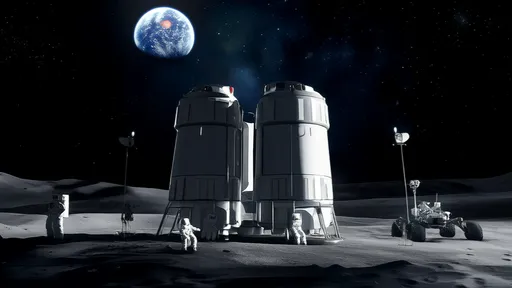
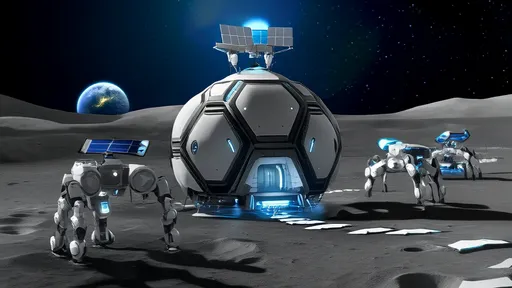
Looking ahead, the implications extend far beyond polar science. The technology being proven in the Arctic is a testbed for future off-world habitats. NASA and other space agencies are closely watching these developments, as the challenges of building on the Moon or Mars—extreme temperatures, low atmospheric pressure, and the need for lightweight, self-deploying structures—are remarkably similar. The lessons learned from creating a sustainable human presence in the Arctic are directly applicable to creating one on other planets. It turns the research station into a prototype for interplanetary exploration.
This shift from heavy, static bases to intelligent, adaptable habitats represents more than just a construction upgrade. It signifies a new philosophy for human presence in extreme environments: one that is lighter, smarter, and in greater harmony with the surrounding world. It empowers scientists with unprecedented flexibility and safety, allowing them to focus on what they do best—unraveling the mysteries of our planet's most remote frontiers. The future of exploration is taking shape, one air beam at a time.